

2026.06.13
We successfully created a rock exhibition at Beppu Ferry Terminal!
On the 2nd Floor of Beppu Ferry Terminal, we created an exhibition of “rocks you can see all over Nishinoshima’! Please take a look at them if you have free time while waiting for the ferry.
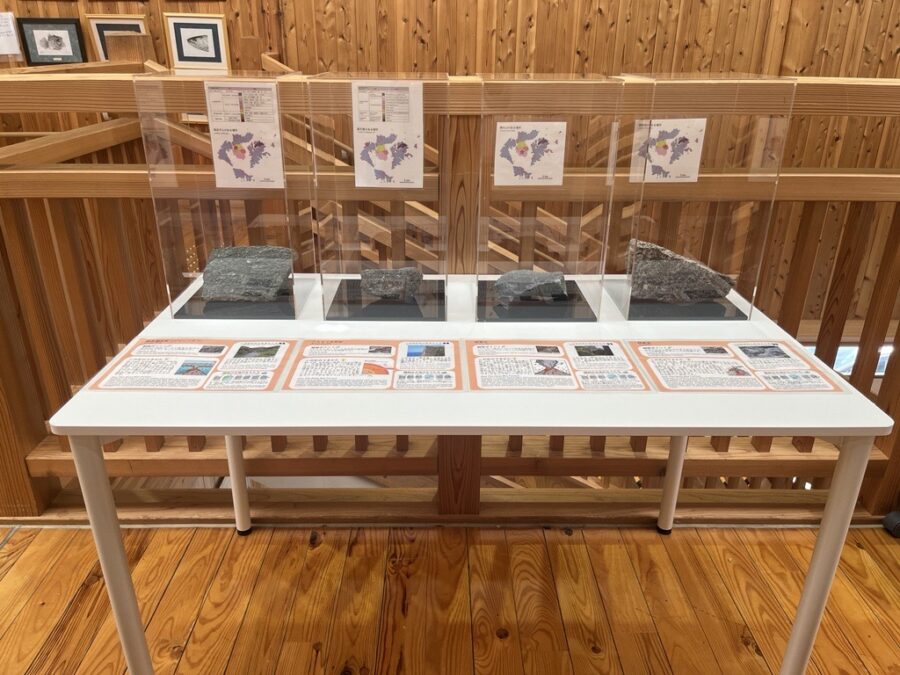
【About the rocks on display】
🪨Green Tuff🪨
Approximately 18 to 26 million years ago when Japan started to detach from the continent. In the middle of when the sea of Japan was made, to a wide extent, there was an abundance of volcanic eruptions ongoing. At that time, it is estimated that the volcanic ejecta was coming out of the eruption under water, which allowed this rock to form. The rock’s green colour is due to minerals that were transformed by hydrothermal activity
🪨Alkaline Basalt🪨
Around 6.3 million years ago, a volcano erupted off the coast of Dōzen, causing the Oki Islands—which had previously been laying on the seabed of the Sea of Japan—to emerge above the surface of the sea. The magma that flowed out at that time turned into lava, which cooled and solidified on the surface to form this rock. As it contains a high proportion of olivine, it is believed to have originally been extremely hot magma that rose rapidly from the mantle.
▶Matengai Cliff, Kuniga Coast」
🪨Trachyte🪨
Around 6 million years ago, following a basaltic eruption, an explosive eruption occurred in the centre of Dōzen. Volcanic ejecta rained down violently onto the ground, where it melted under its own weight and heat before solidifying once more. This rock is richer in alkaline elements (Potassium and Sodium) than volcanic rocks found on the mainland. It is a rare type of rock in Japan.
▶Mt. Takuhi (Central Cone and Takuhi Shrine)
🪨Syenite🪨
Around 6.4 million years ago, magma that had not erupted during a volcanic eruption off the coast of Dōzen slowly cooled and solidified underground, forming this rock. A distinctive feature of this rock is that the minerals are large, due to the slow cooling and solidification process. Whilst granite is composed of plagioclase, quartz and alkali feldspar in roughly equal proportions, syenite is distinguished by the fact that it consists almost entirely of alkali feldspar. This rock is also rarely found in Japan.
▶Quartz Syenite and Hornfels, Ōyama

