

2025.08.20
[Report] Ama Town Mystery Discovery Lab
This was the second instalment of our activities. It explored how we can turn after-school time and spaces into opportunities for spontaneous questioning and learning.
On Tuesday 5 August, we held the Ama Town Mystery Discovery Lab for primary and secondary school pupils at the Ama Town Development Centre, an event designed to help them encounter the ‘whys’ and ‘whats’ of geophysical phenomena.
・ Date and Time: Tuesday 5 August, 10:00–12:00
・ Venue: Ama Town Development Centre (Library Material Library & Wooden Deck)
・ Supported by: Dōzen Furusato Charm Promotion Foundation (Adult Island Exchange Students ‘Welfare Project’ & Primary and Secondary School Student Team), Ama Town Library, Ama Town Board of Education, Traditional Culture and Community Education Section
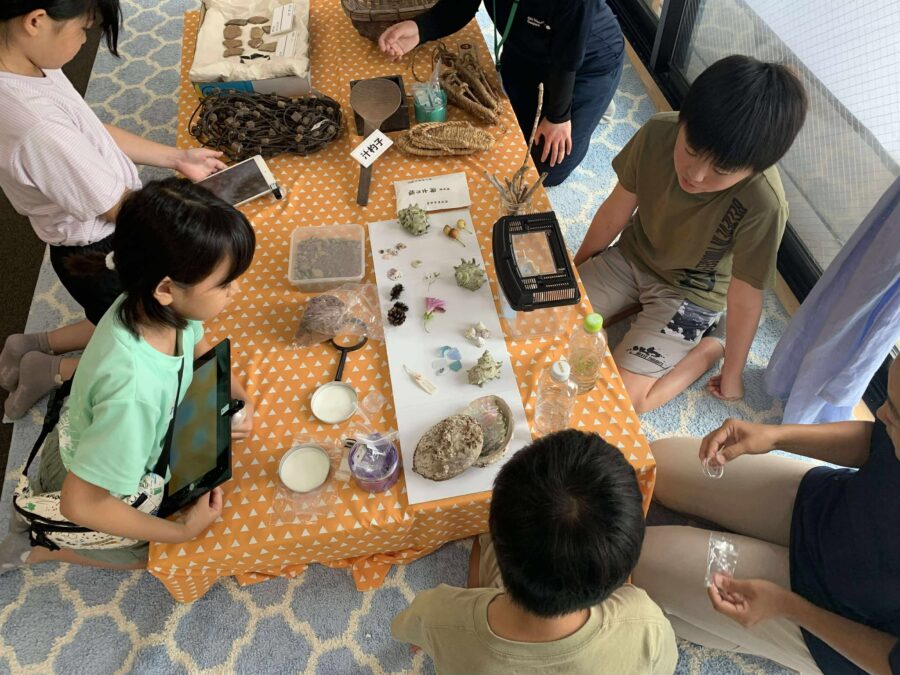
We held this event as part of the Summer Hideout programme, which took place during the summer holidays as a project to create a safe space for primary and secondary school pupils in the town, organised by the Dōzen Hometown Attractiveness Foundation’s Adult Island Exchange Students Welfare Project, in collaboration with a team of primary and secondary school pupils.
―About the Ama Town Mystery Discovery Lab―
We organised this event to create a space where participants could engage in spontaneous exploration of the mysteries of the Oki Islands UNESCO Global Geopark, focusing specifically on its formation, unique ecosystem, and human activities. We designed the programme in accordance with each child’s particularities and interests, taking them to heart. The programme focused on encouraging children to learn through discovery, rather than through basic education.
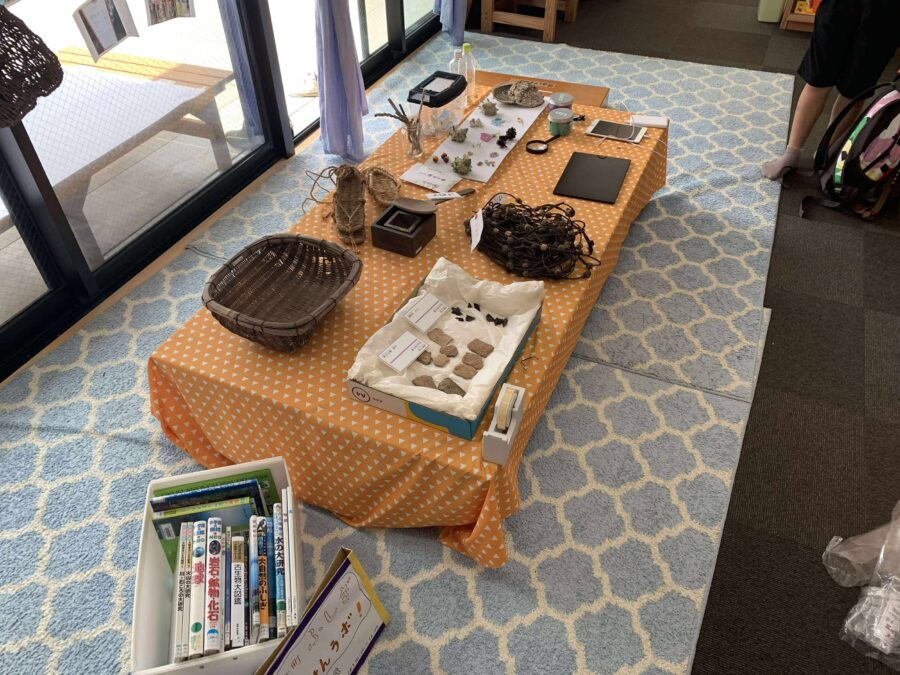
To help participants explore land formation, ecosystems, and human activity in Oki, we prepared rocks, fossils, plants, marine life, and historical tools.
| Formation of the Earth | Unique Ecosystem | Human interactions |
| ・Rock specimens (quartz syenite, basalt, rhyolite)・obsidian ・ earthenware | ・Shark jawbone specimen
・Plants and insects found around the venue ・Small creatures in the pond |
zouri and waraji straw sandals, tauenawa rice-planting rope, masu (wooden rice measurer), etc. |
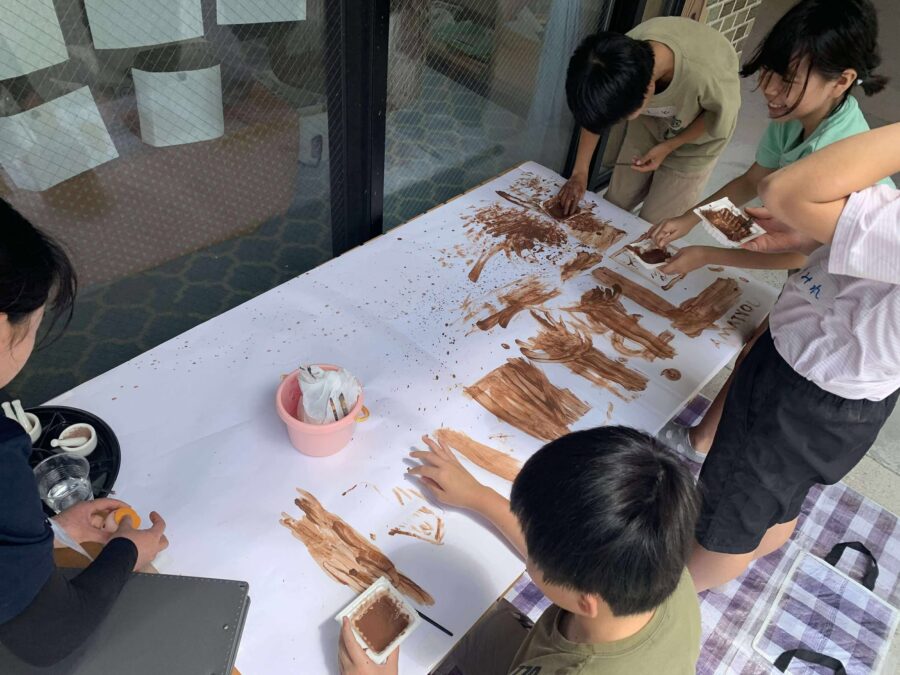
Even though this was a walk-in event requiring no prior registration, we had around eight primary school pupils take part in just half a day! Each child took a natural interest in the prepared materials, from observing items that caught their eye through smartphone microscopes to making paint from soil to draw with. We believe the children were very satisfied with this event. Moving forward, we plan to continue trialling environments that encourage spontaneous questioning and learning, for both primary and secondary school pupils in the town, with a view to incorporating this into the future operations of the education group’s after-school programmes.
・ Details
① Creative Corner
A corner where participants can freely create using various materials from the island related to the formation of the earth, unique ecosystems, and human activities, whilst also making use of some of the materials displayed in the Materials Library (Island Materials inventory) at Ama Town Central Library.
② Drawing Corner
A corner where participants made paint from Ama Town soil and painted pictures together.
③ Observation Corner
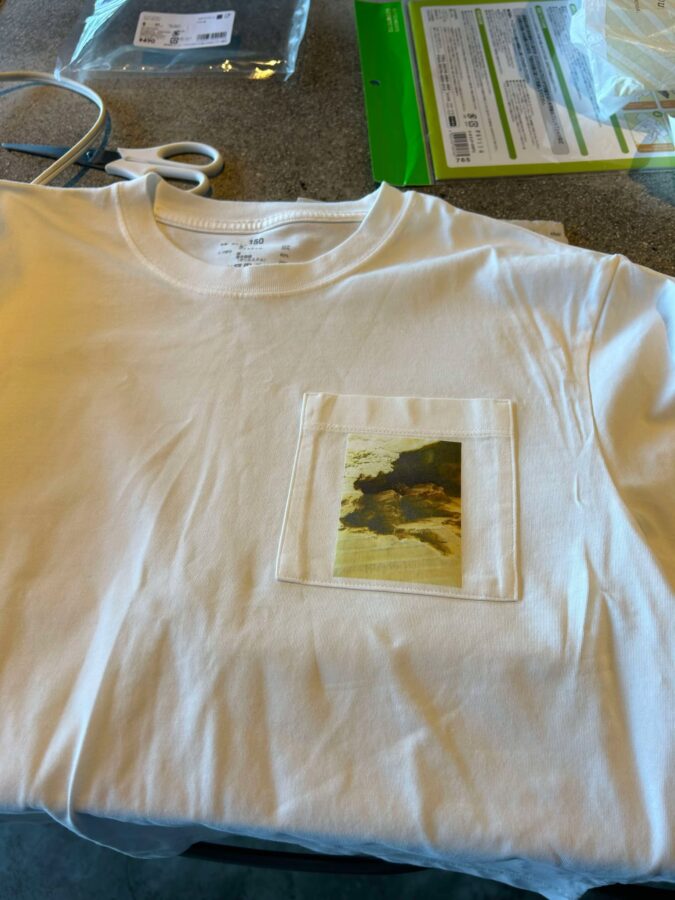
Using a smart device microscope (we used tablets on this occasion), participants were able to pick up various items related to the formation of the earth, unique ecosystems, and human activities, observe the microscopic world, and take photographs.
Furthermore, the photos taken can be iron-on transferred onto T-shirts brought along in advance, creating original Oki Geo T-shirts!
We took lots of fascinating photos where the things we see every day suddenly took on a new appearance, as if the children were encountering them for the first time!
④ Curated Geo-Book Corner
A corner where visitors can relax and deepen their interest in topics such as the Oki UNESCO Global Geopark and photo books about the Earth.
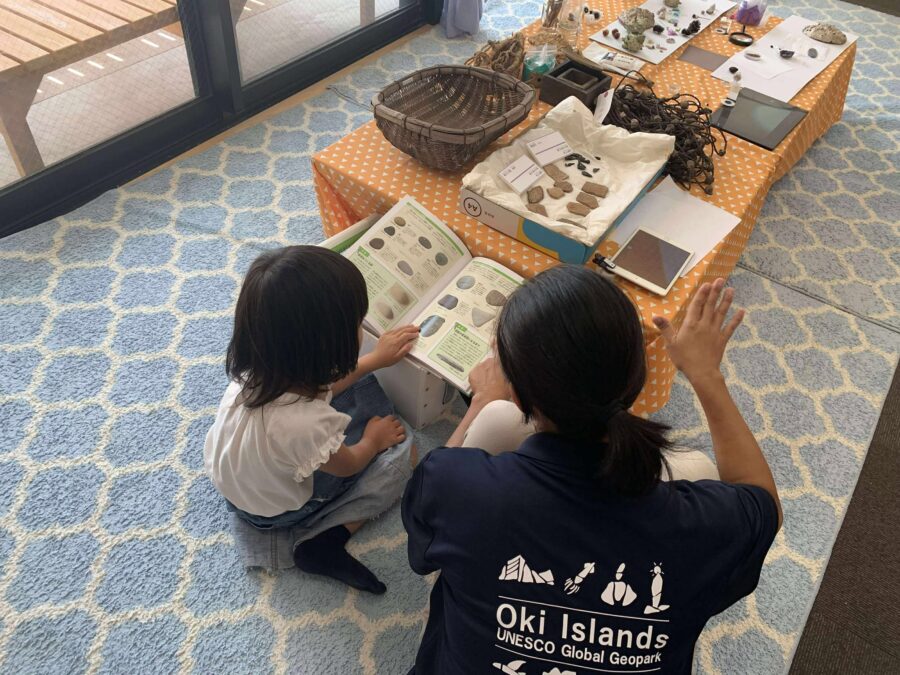
The children who took part not only observed the prepared content with curiosity, asking ‘What’s this?’, but also expressed a desire to view their familiar everyday surroundings with fresh eyes, saying things like, ‘If it looks like this, I’d like to take a look at the holes here (on the library bookshelves) too!’ They also explored the area around the venue with staff, searching for things that caught their eye along the way, thus broadening their interests to whatever piqued their curiosity

